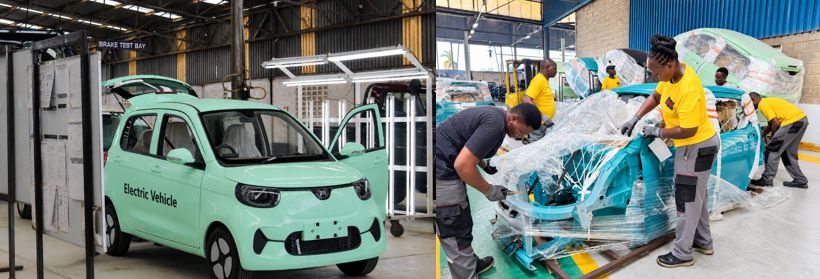
At Associated Vehicle Assemblers (AVA) in Mombasa, investment in electric vehicle assembly is opening up new work for Kenyan technicians and expanding access to cleaner transport. Building the skills to handle the technology has been a critical part of that transition.
Electric buses, passenger vehicles and three-wheelers are becoming part of the work at AVA. Through its initiative, Advancing Electric Mobility Through Local Assembly, the company is responding to demand for low-emission transport while developing the capacity to build these vehicles locally.
AVA reports 80 electric three wheelers, 152 passenger vehicles and 41 electric vans assembled for a total of over 270 electric vehicle (EV) units. Its EV assembly line has also created 61 direct jobs.
Those results required changes inside the factory. An experienced vehicle assembly workforce needed to learn how to work with high-voltage systems, batteries and electrical diagnostics. Local technical experience in these areas was limited, creating a skills gap that AVA had to address as it expanded into electric mobility.
The company’s response combined investment in equipment with practical training. Its experience shows how the shift to cleaner transport can create opportunities in local manufacturing.
Learning while building
AVA worked with its original equipment manufacturer partners to train its assembly teams. EV-specific work instructions and safety procedures gave technicians guidance for the new systems. Pilot builds then provided opportunities to put that knowledge into practice, with continuous coaching on the job.
The team also adapted its existing assembly processes and quality controls. Training was part of the production work itself, allowing technicians to build experience with the technology they would be handling.
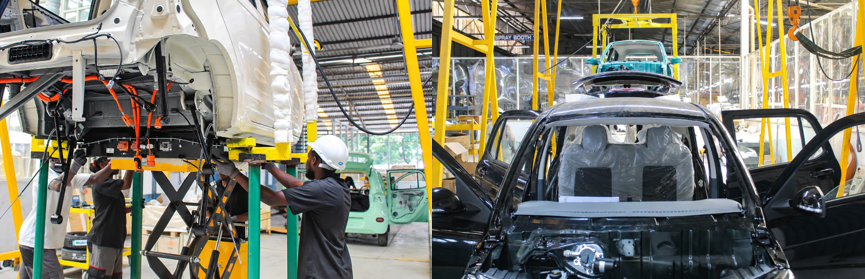
Left: EV battery installation. Right: Vehicles on the assembly line. Photos supplied by AVA.
AVA reports that this approach helped it establish local EV assembly capabilities and upskill Kenyan technicians. The challenge was a shortage of specialized experience; the response gave employees a way to develop it through training and supervised practice.
Alongside this work, the company upgraded its facilities for battery handling, charging interface installation and high-voltage safety. Simba Corporation’s commitment to invest KES 1 billion in a dedicated EV assembly line supports the expansion, including specialized equipment and workforce development. AVA also works with BasiGo, Rideence and Car & Genreal to assemble electric passenger vehicles, buses, vans and three-wheelers locally. These partnerships connect their established manufacturing experience with the technical requirements of electric mobility.
“By combining our decades of manufacturing expertise with clean mobility technologies, we are creating green jobs, reducing emissions, and strengthening Kenya’s position as a regional hub for sustainable industrial growth,” says Daniel Moki, Acting Managing Director at AVA.
Local jobs and lower transport emissions
For employees, EV assembly has opened up work in a developing field of manufacturing and opportunities to gain specialized skills. Transport operators and customers have access to locally assembled, low-emission vehicles, while suppliers and local businesses can participate in the growing EV value chain.
AVA estimates that deployment of its electric vehicles avoids 492 tonnes of carbon dioxide equivalent emissions annually.
A participant of the United Nations Global Compact since July 2024, AVA links the initiative to the environmental commitments in the Ten Principles: Principle 7 on a precautionary approach to environmental challenges, Principle 8 on greater environmental responsibility, and Principle 9 on the development and diffusion of environmentally friendly technologies.
The initiative also contributes to the Sustainable Development Goals (SDGs): SDG 8, Decent Work and Economic Growth, through jobs and skills; SDG 9, Industry, Innovation and Infrastructure, through local manufacturing; and SDG 11, Sustainable Cities and Communities, and SDG 13, Climate Action, through cleaner transport.
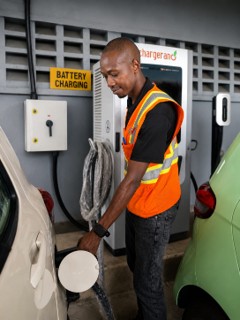
An employee connects a vehicle to a charger. Photo supplied by AVA.
“Our EV assembly initiative demonstrates that sustainability and business growth can go hand in hand,” continues Daniel Moki. “Through local assembly, strategic partnerships, and workforce development, AVA is delivering measurable environmental and social impact while supporting Kenya’s low-carbon development agenda.”
As AVA develops its electric vehicle operations, the technicians’ experience becomes part of its manufacturing capacity. The skills gap made clear why investment in people needed to accompany investment in equipment. Addressing it has helped the company assemble cleaner vehicles locally while giving Kenyan workers a role in the transition.